
Properties and mechanism of action
While research into the molecular mechanisms of action of probiotics is ongoing, some of their functions include3:
Colonizing intestinal microbial communities*
Supporting balance of fecal enzymatic activities*
Producing short-chain and branched-chain fatty acids*
Producing cell adhesion and mucin*
Supporting the immune system*
Scientific support
Three specific probiotic strains have been well studied for their digestive and immune benefits:
Bifidobacterium breve is a gram-positive bacterium which is one of the first colonizers of the infant gut. B. breve strains have been well studied in infants, demonstrating that:
A 3 month administration of 2 strains of B. breve in healthy breast fed infants was shown to be well tolerated and supportive of gut health"
Administration for 3 months of 2 B. breve strains (B632 and BR03) helped to restore the gut microbial balance5*
When used daily for 3 months, B. breve significantly reduced crying time in babies due to occasional gas or stomach upset6*
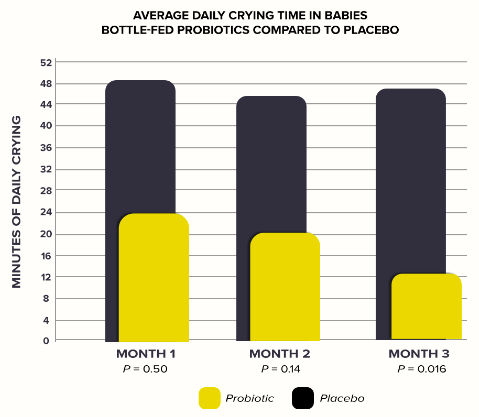
Minutes of daily crying in the probiotic group compared with placebo during the first, second, and third month of treatment, respectively.6
Bacillus coagulans is a gram-positive, spore-forming bacterium with high survival tolerance to acid and bile conditions. It has been extensively studied in both babies and adults, demonstrating that B. coagulans:
Supports key aspects of innate immune defense mechanisms7*
Bacillus subtilis is another gram-positive bacteria that can survive extreme conditions, which has been studied in children and adults for over 40 years. B. subtilis has been demonstrated to:
Survive transit through stomach hydrochloric acid8*
Support immune function and improve gut health9*
Bacillus subtilis is another gram-positive bacteria that can survive extreme conditions, which has been studied in children and adults for over 40 years. B. subtilis has been demonstrated to:
Survive transit through stomach hydrochloric acid8*
Support immune function and improve gut health9*
*These statements have not been evaluated by the Food and Drug Administration. This product is not intended to diagnose, treat, cure, or prevent any disease.
Ingredient details are provided as general information and are not intended to be associated with any specific Zarbee’s® products.
REFERENCES:
1. Cao J, Yu Z, Liu W, Zhao J, Zhang H, Zhai Q, Chen W. Probiotic characteristics of Bacillus coagulans and associated implications for human health and diseases. J Funct Foods. 2020;64:103543. 2. Didari T, Mozaffari S, Nikfar S, Abdollahi M. Effectiveness of probiotics in irritable bowel syndrome: Updated systematic review with meta-analysis. World J Gastroenterol. 2015;21(10):3072-3084. 3. Plaza-Diaz J, Ruiz-Ojeda FJ, Gil-Campos M, Gil A. Mechanisms of Action of Probiotics [published correction appears in Adv Nutr. 2020 Jul 1;11(4):1054]. Adv Nutr. 2019;10(suppl_1):S49-S66. 4. Aloisio I, Prodam F, Giglione E, et al. Three-month feeding integration with Bifidobacterium strains prevents gastrointestinal symptoms in healthy newborns. Front Nutr. 2018;5:39. 5. Quagliariello A, Aloisio I, Bozzi Cionci N, et al. Effect of Bifidobacterium breve on the intestinal microbiota of coeliac children on a gluten free Diet: a pilot study. Nutrients. 2016;8(10):660. 6. Giglione E, Prodam F, Bellone S, et al. The association of Bifidobacterium breve BR03 and B632 is effective to prevent colics in bottle-fed infants: a pilot, controlled, randomized, and double-blind study. J Clin Gastroenterol. 2016;50(Suppl 2):S164-S167. 7. Jensen GS, Benson KF, Carter SG, Endres JR. GanedenBC30™ cell wall and metabolites: anti-inflammatory and immune modulating effects in vitro. BMC Immunol. 2010;11:15. 8. Hong HA, Duc LH, Cutting SM. The use of bacterial spore formers as probiotics. FEMS Microbiol Rev. 2005;29(4):813-835. 9. Rhayat L, Maresca M, Nicoletti C, et al. Effect of Bacillus subtilis strains on intestinal barrier function and inflammatory response. Front Immunol. 2019;10:564.